From LEGO bricks to championship robots.
FIRST Robotics teams in 25+ cities across the East Bay, from LEGO bricks in 1st grade to 120-pound competition robots in high school. Kids learn engineering by doing, and the older ones teach the younger ones.
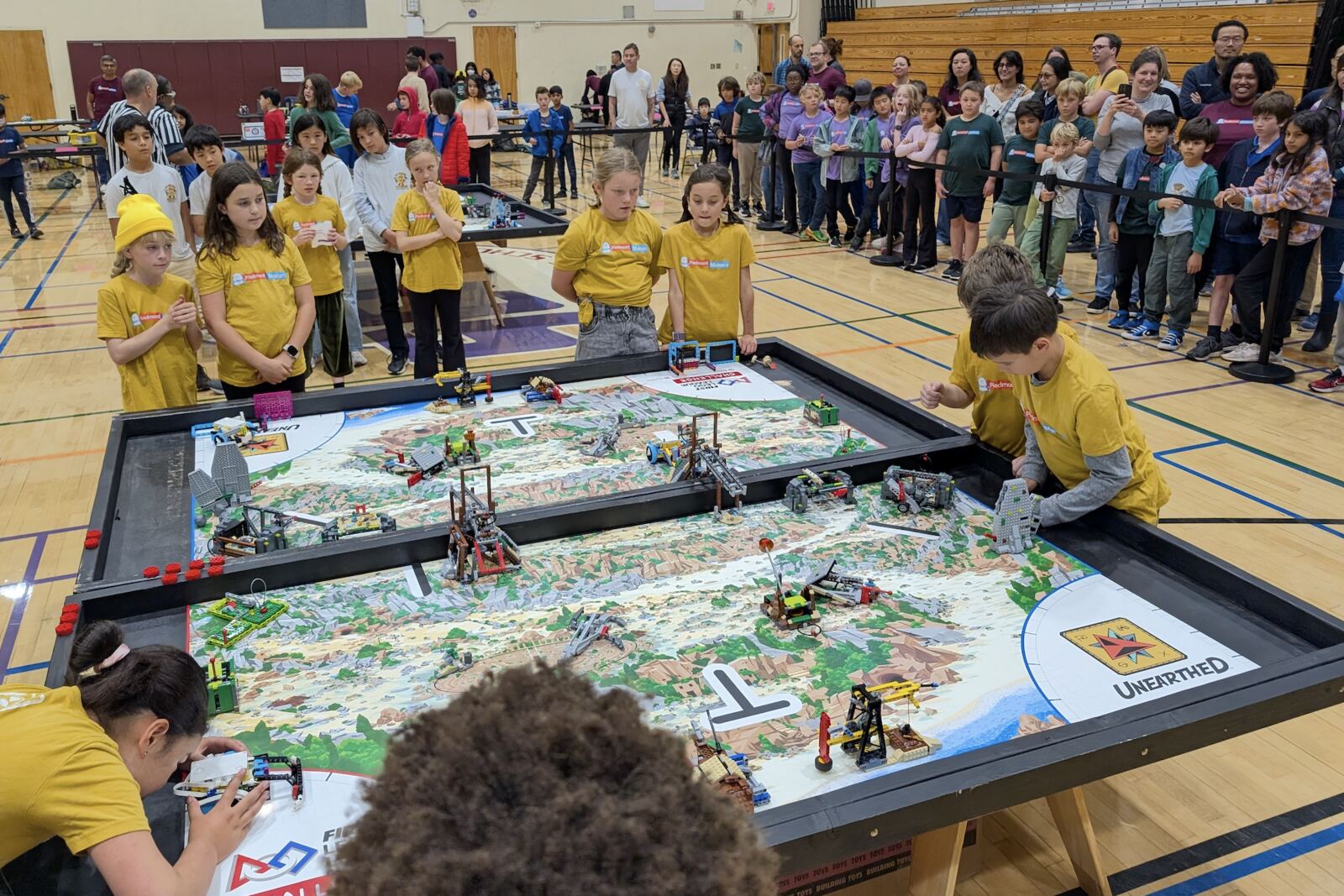
We operate the largest community-based youth robotics league in the United States: 1,000+ kids on 150+ teams.
STEAM shouldn't depend on your zip code or your family's income.
-
1,000+
kids on robotics teams
-
40%
girls in LEGO League
-
10%
from Title 1 schools
-
46%
from outside Piedmont
Pick the right team for your kid.
LEGO League sign-ups run March through May; FTC and FRC open later, into the summer. Each level below shows whether its sign-ups are open right now. Financial aid is available; cost should not be a barrier.
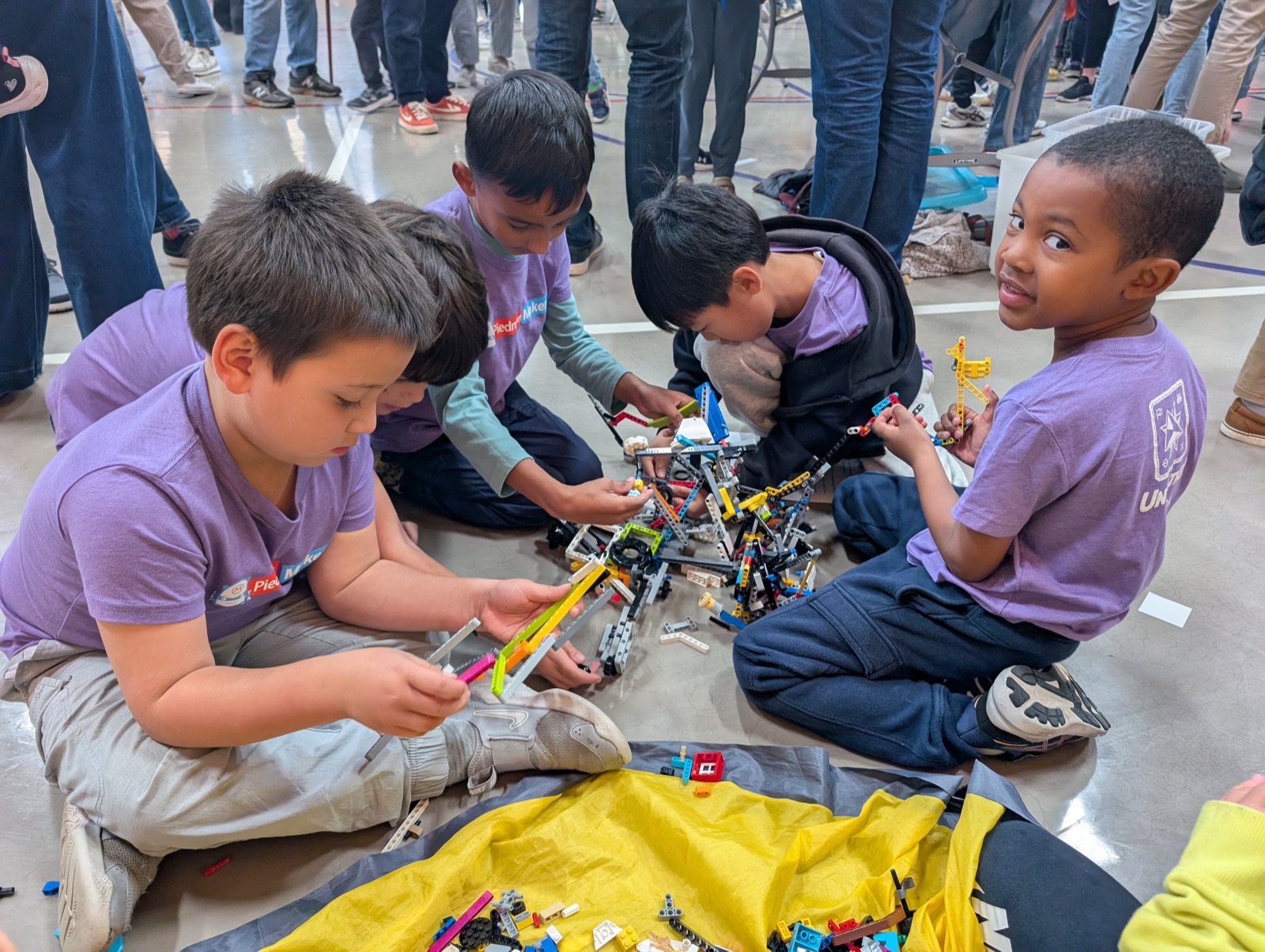
LEGO League Explore team building during a session
Grades K–3
Your kid's first robot. Kindergartners through 3rd graders build with LEGO Spike Essentials and code with drag-and-drop blocks. Motors, sensors, no fear.
Teams of 5–6 kids meet at a coach's home for 12 weekly hour-long sessions, then present their build and poster at the LEGO League Explore Festival at Piedmont Middle School the weekend after Thanksgiving. Two parent volunteers coach each team. Piedmont Makers supplies the LEGO kit, week-by-week lesson plans, August coach training, and an active Slack channel for coaches who haven't done this before.
- Season
- Aug–Dec
- Cadence
- 1× weekly · 1 hour
- Team size
- 5–6 kids
- Cost
- $200 / participant
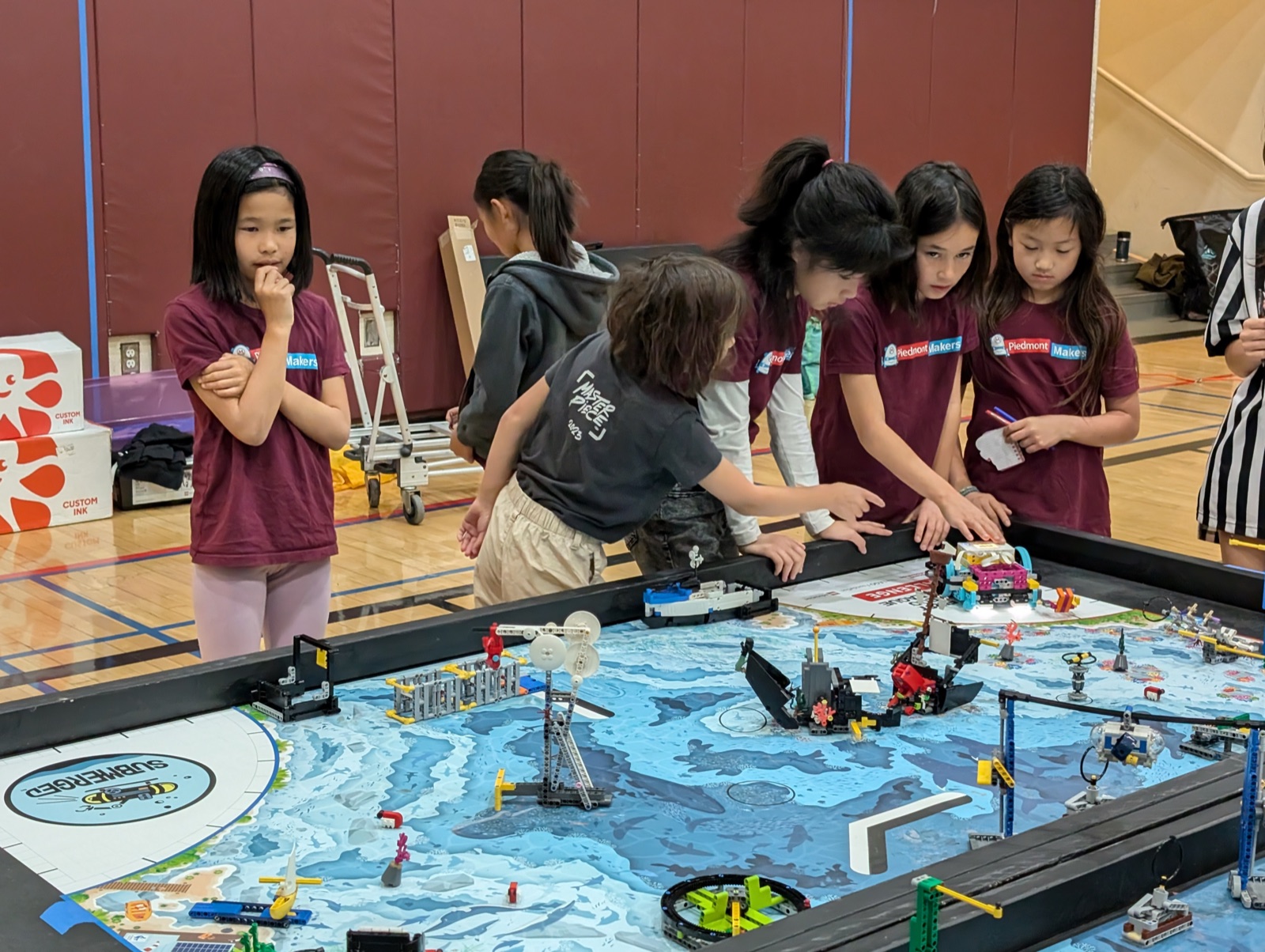
LEGO League Challenge team at the SUBMERGED season tournament
Grades 4–8
4th–8th graders build autonomous LEGO robots, code in block programming or Python, and research a real-world problem for their Innovation Project.
Teams of 6–8 meet 1–2 times a week from August through December. The season ends at the Piedmont Makers Community Tournament at Piedmont Middle School: 12 game tables, two arenas, real referees, awards including Best Costume. Teams who want more can opt into the Competitive Track for regional qualifiers in January and February. Piedmont Makers delivers a 4'×8' game table to the coach's house and supplies the LEGO Spike Prime kits, week-by-week guides, August coach training, and a Slack community of 130+ coaches.
- Season
- Aug–Dec
- Cadence
- 1–2× weekly · 2–3 hours total
- Team size
- 6–8 kids
- Cost
- $400 / participant
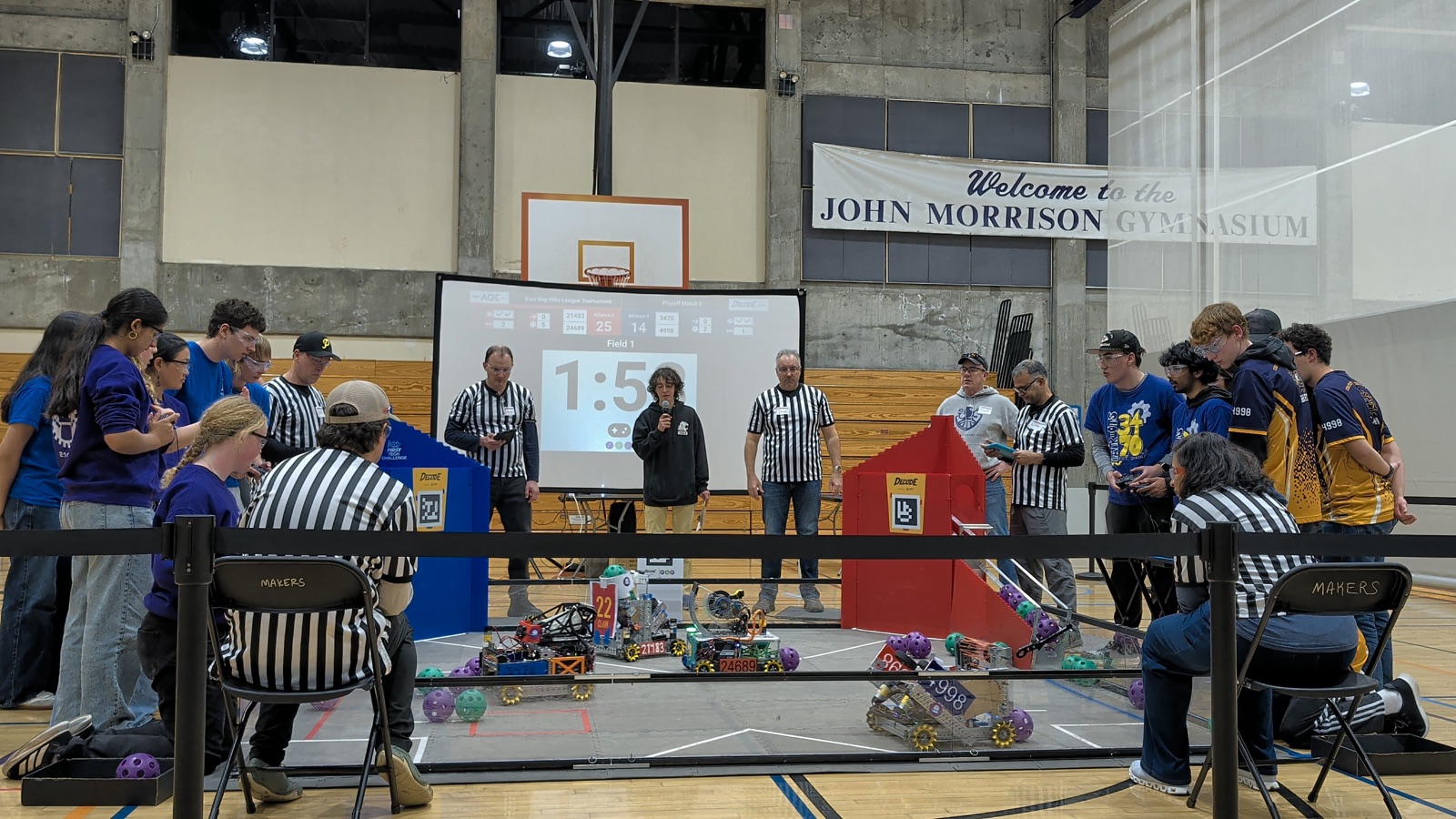
FTC Team 18133 at robot inspection
Grades 7–12
From LEGO to metal. 7th–12th graders build 18-inch-cube robots from REV, TETRIX, and goBILDA components, code them in Java, and compete in two-robot alliances on a 12'×12' field.
Teams of 6–12 kids practice at coach/parent homes or our robotics practice facility in Oakland, learning Java programming, CAD, and digital fabrication along the way. They compete in the East Bay Hills FTC League qualifying tournaments. Many teams bring on a Highlander Robotics high schooler as a student mentor so a non-STEAM parent can still run a strong team.
- Season
- Sept–Feb
- Cadence
- 2× weekly · 2–6 hrs
- Team size
- 6–12 kids
- Cost
- $500 / participant
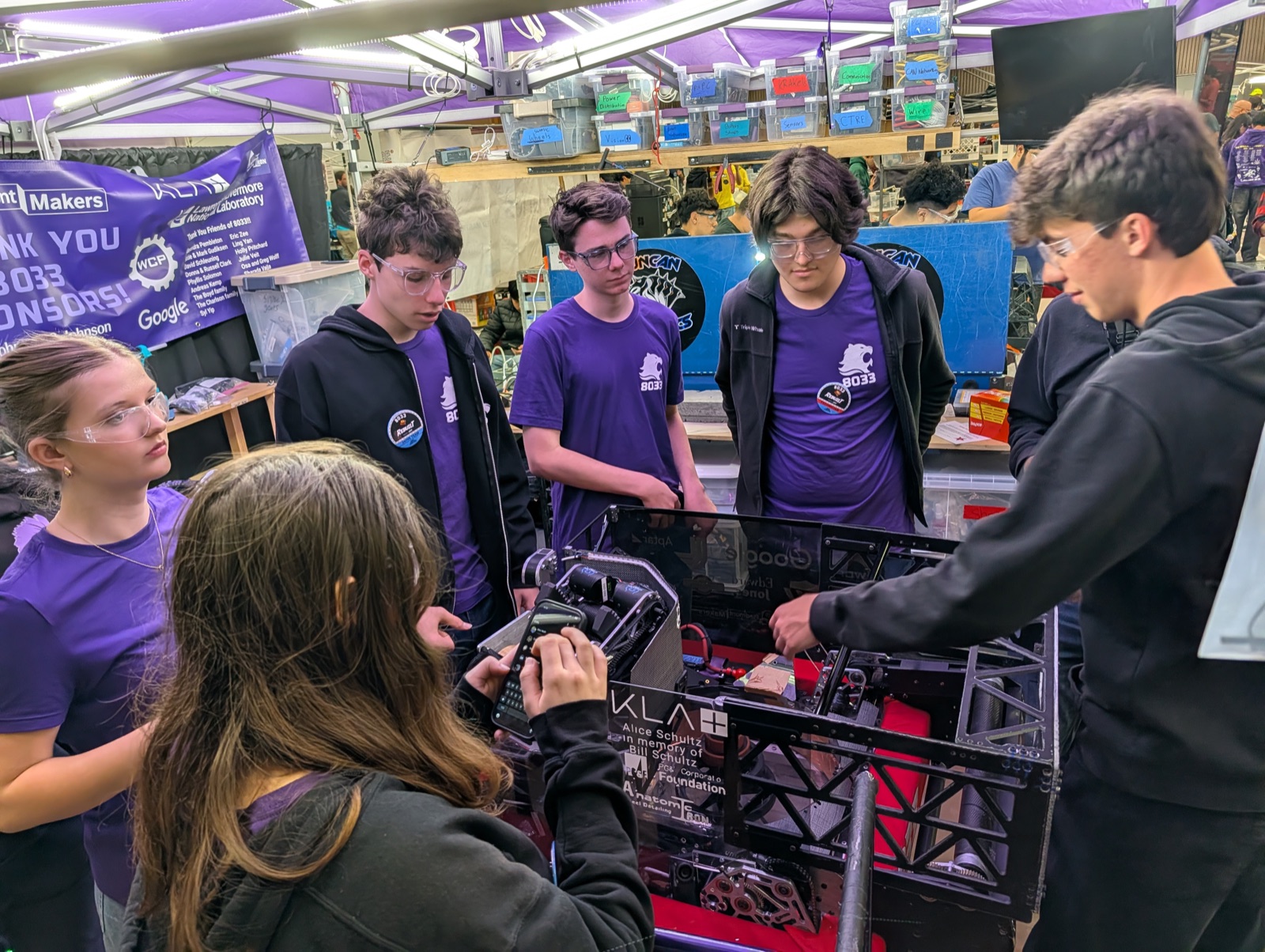
Highlander Robotics 8033 huddled around the robot at a tournament
Grades 9–12
The big leagues: 120-pound competition robots, full build season, serious engineering. Team 8033 has reached the FIRST World Championship in Houston four times, most recently in 2025.
Highlander Robotics fields two teams, 8033 and 8433, with 85 kids organized into specialty subgroups (mechanical, electrical, software, scouting, fundraising, business) so members can focus on what they love instead of doing everything. Practice happens at our robotics practice facility in Oakland, the only community-accessible regulation FRC field in the Bay Area. Beyond build season, Team 8033 develops Lovat (a scouting app used by 800+ FRC teams worldwide), runs the annual a-CAD-emy summer camp teaching middle schoolers Onshape CAD, mentors local LEGO League teams, and shares training programs with 40+ other FRC teams worldwide.
- Season
- Aug–June · build season Jan–March
- Cadence
- Multiple weekly meetings
- Team size
- 85 kids on two teams
- Cost
- $800 / participant
Parent questions, answered.
Still have something specific? Email robotics@piedmontmakers.org.
Do you accept kids who don't live in Piedmont? + −
Does my kid need engineering experience to join? + −
Do coaches need engineering experience? + −
We don't have a team yet. Can my kid still register? + −
My kid is in 7th or 8th grade. Should they do LEGO League Challenge or FTC? + −
My kid is in high school. FTC or FRC? + −
What does it cost, and what is included? + −
When do registrations open? + −
I heard FIRST and LEGO are ending their partnership. What happens to LEGO League? + −
Coach training and open-house materials.
Coaching is the most volunteer-intensive thing we do. We supply lesson plans, training, and a community of coaches to learn from. These materials are open to anyone considering coaching.
Interested but unsure? Email robotics@piedmontmakers.org.
- →
Google Slides
FLL Explore — Coach Training 2026–27
- →
Google Slides
FLL Challenge — Coach Training 2026–27
- →
PDF
FLL Challenge — Team Guide
- →
Google Slides
FTC — Coach Training 2026–27
- →
Video
K–8 Open House Video (2024)
- →
Google Slides
Advanced Robotics Open House (2025)
- →
Google Slides
FRC Highlander Robotics 8033 Open House (2025)
Two ways to register your kid.
Both are valid. The first one usually leads to a stronger season.
Register a pre-formed team
Round up your kid's friend group, assemble the team, and identify one parent as head coach and one as assistant. FIRST requires two coaches per team. Pre-formed teams give you more control over team composition and the support network of parents around the team, and they usually lead to better outcomes for the kids.
Register as an individual
Tell us your kid's age, school, gender mix, and competitiveness preferences. We place kids on teams over the summer. Registration runs the whole window with no cap, so there's time to recruit friends and form a team yourself.
You'll be asked whether you can serve as a parent coach. Motivated parent coaches are the difference between a team that forms and one that doesn't.
LEGO League sign-ups run March through May each year; FTC and FRC open later in the year. Questions? robotics@piedmontmakers.org